-
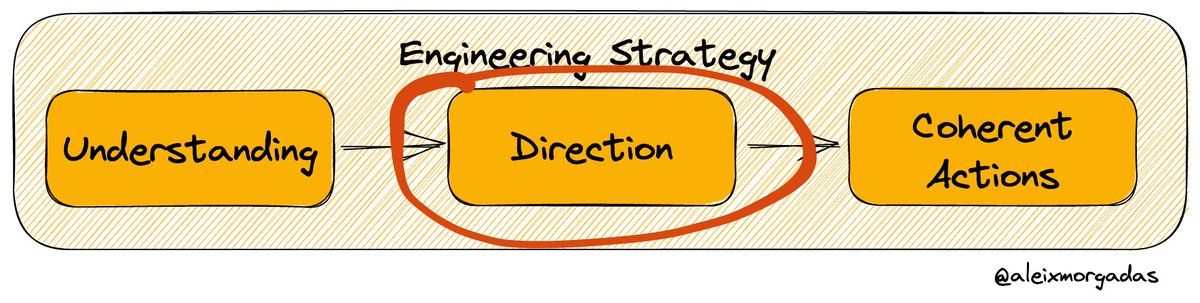
1/8 I have been thinking about the direction part of an engineering strategy The first time I shared it, I focused on helping people to move in a shared understanding of where we want to go. BUT, it doesn't share under which conditions we should revisit it 👈 How do we fix it?Permalink On twitter.com
❤️ 3 Favorites Mood +8 🙂
-
2/8 If you want to know more about the direction component of an engineering strategy, check out this post. learnings.aleixmorgadas.dev/p/designing-an-engineering-strategy-c98Permalink On twitter.com
-
3/8 A direction is set under a particular context and assumptions. In very uncertain environments, those can be fragile as new learnings might change rapidly in the initial context. Which it's good and needed! Indeed, the purpose of learning fast is to react to those changes.Permalink On twitter.com
-
4/8 I identified a flaw in the proposal I made. It doesn't help people to know under which conditions the strategy should be revisited.Permalink On twitter.com
-
5/8 Example: Direction: Improve Mobile resiliencyPermalink On twitter.com
-
6/8 An engineering strategy, either we "delivered" it, or the context in which it was made changed enough to no longer make sense. I missed the latter part.Permalink On twitter.com
-
7/8 I should have pointed out that you need to annotate or make clear under which assumptions and context a direction has been set, and if some of those conditions change, we need to reconsider the strategy.On twitter.com
-
8/8 My recommendation when designing engineering strategies. Make clear the assumptions, context, and conditions on which the one is based and, in case some of that part changes, that we need to review it. Making it explicit will help people to have the right conversations.Permalink On twitter.com
-
9/8 😅 Direction: Improve Mobile resiliency Review strategy when: The outcome is reached - Change failure rate decreases to X% The context changed: - Business stop investing in mobile ABC initiative No impact - After 2 months, our metrics aren't improving at a good peacePermalink On twitter.com